
CEO@SEA: Blog 6 - Beauty and Terror, All Rolled Into One
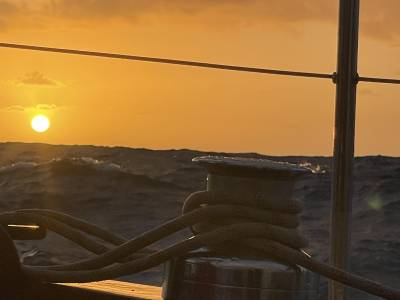
Somewhere around day sixteen, I started doing the maths on how many times Supertaff has rolled since we left Las Palmas. Too much time on my hands. The number came out at roughly 600,0000 back-and-forth motions so far. That is the price of crossing the Atlantic in a heavy 1970s ketch.
It also explains why running a business from the chart table feels a bit like trying to type inside a washing machine.
People assume the hardest part of an Atlantic crossing is physical. The night watches, the wet decks, the broken sleep. It isn’t. The real challenge is the mental landscape. You can be fine for days, then something tiny chips your confidence and suddenly you are wobbling. Our own messages over the past week have shown it. Some were upbeat. Some weren’t. Some sounded like a slightly deranged weather reporter after too many night shifts.
The flu bug that swept through the crew was the clearest example. One minute we were laughing at the madness of the sea state, the next everyone went quiet. Tired. Flat. Counting the miles with more hope than humour. That is the rhythm out here. High, low, high, low. Beauty and terror, bundled together, twenty-four hours a day.
For me, as someone who spends his life thinking about systems, people, risk and opportunity, this has been the greatest test. Entrepreneurs are not swashbuckling heroes. They are simply critical thinkers with an unusually high tolerance for uncertainty. Out here, uncertainty becomes feral. You don’t just wonder whether a partner will deliver or whether a market will swing. You wonder whether the rig will tolerate this wind, whether that rattle was new, whether a small oversight will become a big problem. Confidence and fear cycle every single hour and there is absolutely no off switch.
It is, quite literally, a mind f#ck. Apologies for the language, but nothing else is honest enough.
Now we are just 400 miles from St Lucia. You can smell land. You can imagine the stillness of a flat bed. You can picture the cold beer and the faces of friends waiting at Boatshed Caribbean. And that is precisely the moment the biggest psychological trap appears. Soldiers in Vietnam had a phrase for it. “Getting short.” You think you are nearly safe. That is when danger rises. You are not in until you are in.
So we stay focused. We keep Supertaff safe. We keep the crew relaxed. We do our work from a boat that has rolled over a million times and will roll a few hundred thousand more before this is done. And we stay honest about what this actually feels like, because varnishing the truth helps no one.
This is a huge athletic event, a technical challenge, and an emotional one too. It stretches every part of you. It makes you confront yourself, your doubts, your limits. And it proves something important in business and in life.
You do not get stronger by avoiding uncertainty. You get stronger by moving through it, one imperfect mile at a time.
Supertaffers x
Image Gallery

Comments 0
Please note this comments section is public. Please do not post your personal details here. Please read our commenting guidelines before posting.
Login or register for free